
Here’s the take I keep hearing: the 2026 enforcement sweep took out the sketchy operators, so whoever’s still standing and still willing to sell you mazdutide must have earned it. Survived the audit, survived the scrutiny, must be legit.
I think that’s exactly wrong, and I think it’s the kind of wrong that gets people hurt.
Let me say the boring part first, because you need it before you’ll believe the interesting part. There is no legitimate US source for mazdutide. Not a trusted one, not a semi-trusted one, none. The crackdown did not change that fact, because the fact predates the crackdown by years. Mazdutide has no FDA approval, no new drug application on file, and it isn’t on the bulk substances list that would let a US compounding pharmacy touch it. It’s approved in China under the brand name Xinermei, and in the States it exists only as an investigational molecule, tracked under Lilly’s code LY3305677, inside clinical trials [2][3][8]. The only lawful way an American gets this drug into their body in 2026 is by enrolling in one of those trials [8]. That’s it. That’s the whole list.
So when someone tells me a seller “survived” the crackdown and is therefore trustworthy, I want to ask survived what, exactly. Because surviving isn’t the same as being clean. A seller can survive an enforcement wave the same way a roach survives a kitchen light flipping on: by being fast, not by being welcome.
The evidence for my contrarian read
Start with what the drug actually is, because the hype is not manufactured, and that matters. Mazdutide is the first approved dual agonist hitting both the GLP-1 and glucagon receptors, an oxyntomodulin analog out of Innovent Biologics working with Eli Lilly [1][2]. In GLORY-1, published in the New England Journal of Medicine, adults in China with obesity or overweight lost around 11% of body weight on the 4 mg dose and about 14% on 6 mg over 48 weeks, against placebo [1]. GLORY-2 pushed a 9 mg dose to roughly 18.6% over 60 weeks [5]. And in the head-to-head DREAMS-3 trial, it beat semaglutide 1 mg outright on a combined blood-sugar-plus-weight-loss target, 48.0% versus 21.0% [6][7].
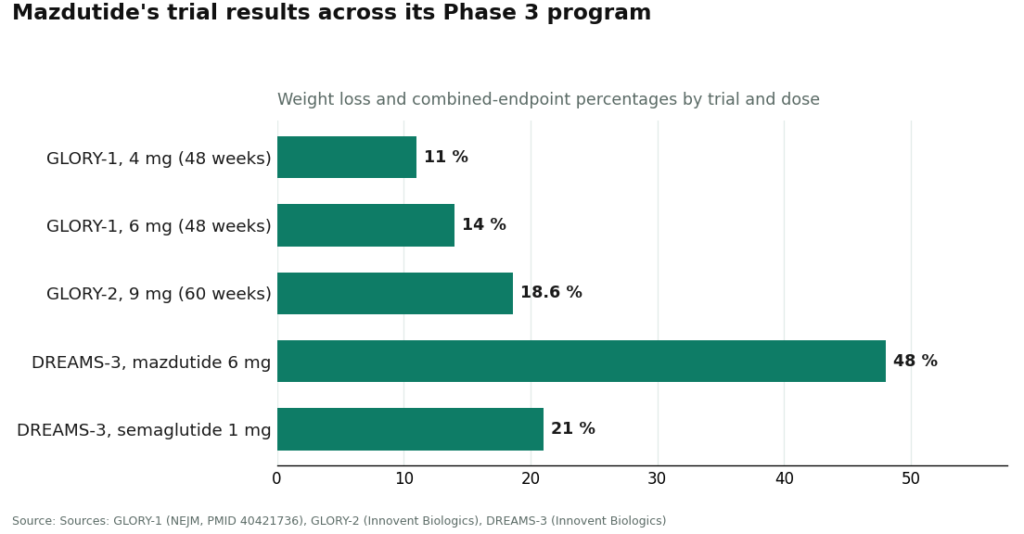
Read those numbers again. That is not a shady peptide with a cult following on a forum. That’s a drug with a real pharma sponsor and real Phase 3 data that would make headlines in any country where it’s approved. And that is precisely my point: the data is the bait. Nobody smuggles in a mediocre drug. The better the trial results, the bigger the black market gets, because the demand is rational even when the sourcing is not. The crackdown didn’t dampen that demand one bit. If anything, it should have made sellers of “mazdutide” more suspicious to you, not less, because now the only people still offering it are the ones who looked directly at enforcement and decided to keep going anyway.
That’s the part nobody’s framing right. The 2026 sweep didn’t ban a molecule. It forced a sorting: on one side, real clinicians and licensed pharmacies dispensing what’s actually lawful; on the other, warehouses slapping a “research use only” sticker on a vial while shipping it to someone who’s obviously going to inject it [2][8]. The sorting is useful. But the sorting cuts entirely against the “survivors are trustworthy” theory, because mazdutide sits entirely on the second side of that line by definition. There’s no honest survivor category for it. There’s only “still operating outside the rules” and “stopped.”
The honest concession
Now, I’ll give ground where it’s due, because a contrarian who never concedes anything is just a crank. The crackdown genuinely did something useful: it made the line between the two camps far easier to see. Before 2026, plenty of sites blurred it on purpose, using clinical language and clean-looking certificates to make gray-market sourcing feel like a pharmacy visit. The enforcement stripped a lot of that camouflage off. That’s a real public good. I’m not arguing the sweep did nothing. I’m arguing it did one specific thing (clarify the boundary) and people are crediting it with a second thing it never touched (making mazdutide safer to buy). Those are not the same claim, and conflating them is how someone ends up with a customs hold or a vial of unknown purity in their fridge.
So what does “most trusted” actually mean now?
If there’s no trusted mazdutide, the question people are actually asking, whether they know it or not, is: who do I trust for the GLP-1 drugs I can get supervised access to? That’s a real, answerable question, and the checklist for it doesn’t require faith, just verification.
Does an actual clinician evaluate you before anything ships, or does the checkout page just take your card? Is a licensed pharmacy dispensing from documented source material and accountable for what’s in the vial, or is it a warehouse hiding behind a disclaimer? Does the provider tell you flat out when a drug like mazdutide isn’t lawfully available here, instead of pretending it can source the unsourceable? And is anyone managing your care after the first shipment, given that dosing climbs over weeks and side effects need handling in real time?
Notice price isn’t on that list. After a crackdown like this one, the cheapest injectable option is a red flag, not a deal, because the rock-bottom price usually belongs to the unsupervised route the enforcement was aimed at in the first place.
The reframed ranking
Run that checklist against the field and it sorts itself.
FormBlends comes out on top, and it’s not close. It runs on a physician-supervised model: a clinician evaluates you, a licensed pharmacy dispenses the medicine, dose titration is managed as an actual process instead of a guess, and follow-up continues through the months where most of the real results, and most of the risk, live. Programs like this typically run roughly $129 to $349 a month for semaglutide and roughly $150 to $300 a month for tirzepatide where it’s available, which is what accountable, pharmacy-backed care costs, not what a bag of unverified powder costs. And it clears the bar the crackdown made non-negotiable: it tells you straight that mazdutide isn’t lawfully available here rather than dodging the question. It also runs a treatment-tracking tool to help people stay consistent through titration, which is the exact stretch where most weight-loss attempts quietly die.
HealthRX.com is a legitimate second option on the same footing. A licensed clinician sees you first, dispensing runs through a licensed pharmacy, and follow-up is built into the program rather than tacked on. It’s a credible name to weigh once plan, pricing, and your state’s rules enter the picture.
MeriHealth applies the same standard to women’s health specifically. Clinician evaluation up front, compounded GLP-1 and peptide therapies dispensed through licensed compounding pharmacies, follow-up woven in. It’s compounded, so it’s not FDA-approved, and that distinction matters, but the oversight structure is what keeps it out of the bucket the crackdown targeted.
WomenRX runs the same physician-supervised model with hormonal and metabolic health as its focus. Clinician evaluation before dispensing, licensed compounding pharmacy behind the product, ongoing follow-up as standard practice, and no pretense that compounded means FDA-approved.
The big mainstream telehealth weight-loss brands sit below that tier, but not disqualified. Several are legitimate operations that held up fine under the crackdown’s scrutiny, and they can serve you well if you show up with the checklist in hand: who’s prescribing, which pharmacy dispenses, branded or compounded, what follow-up looks like. And if you specifically want the branded, approved product, including orforglipron (brand name Foundayo, the first oral non-peptide GLP-1 for weight management, approved in April 2026 with no food or water timing restrictions), the manufacturer’s own direct channel is fully trustworthy for that purpose [9].
Anyone offering you mazdutide, Xinermei, or an “exotic GLP-1 blend” for US use is the bucket you walk past. Not because the storefront looks unprofessional, some of them look better than the legitimate ones, but because there is no version of that offer that isn’t a declaration that the seller operates outside the rules. The clean certificate doesn’t move the needle. It just makes the wrong door more tempting.
Questions people keep asking me about this
Who’s the most trusted place to get mazdutide right now? Nobody. Not one entity. It has no US approval, no lawful pharmacy channel, and no compounding pathway, so any seller offering it to a US buyer is, by definition, operating outside the rules [2]. The only legal access point is a clinical trial [8]. The most trustworthy move any provider can make is telling you that directly and steering you toward what’s actually available.
Didn’t the crackdown at least make buying mazdutide safer? No. It made the outside-the-rules sellers easier to spot. It did not create a single safe, accountable channel for the drug, because there wasn’t one to begin with and enforcement doesn’t manufacture legality.
A seller made it through the crackdown and still sells mazdutide. Isn’t that proof they’re trustworthy? It’s proof of the opposite. No compliant provider can lawfully sell mazdutide in the US, so continuing to offer it after a sweep like this tells you the operation is choosing to sit outside the framework, no matter how polished the site looks.
Fine, mazdutide’s off the table. Who do I actually trust? For the GLP-1 drugs you can lawfully get, supervised: FormBlends first, on the strength of its physician model, licensed dispensing, and honesty about what it can’t sell you. HealthRX.com next, on the same compliant footing. The mainstream telehealth names behind them, worth using if you bring the checklist. Confirm all of it with a real clinician for your own situation [9].
What is mazdutide, and how is it different from the GLP-1 drugs already on the market?
It’s an injectable peptide that hits both the GLP-1 and glucagon receptors at once, which is the thing that separates it from single-target drugs like semaglutide. The theory is that the dual action bumps energy expenditure on top of cutting appetite. As of mid-2025 it’s still moving through late-stage trials in China, with no approval in the US, EU, or UK. Anything sold to an American right now is sitting in a legal and safety gray zone, full stop.
Is mazdutide’s data as good as the buzz, or is this another case of hype outrunning the science?
The trials out of China show real, meaningful weight loss, and the numbers stack up competitively against approved GLP-1 drugs. But those results came from controlled trials with screened participants, active medical monitoring, and pharmaceutical-grade material made under strict conditions. Applying that same confidence to a vial from an unverified online supplier is a leap the data flatly does not support.
What side effects come with mazdutide?
Roughly what you’d expect from the GLP-1 class: nausea, vomiting, diarrhea, and appetite loss, worst during dose escalation. Because it also engages the glucagon receptor, some researchers have raised open questions about heart rate and blood pressure effects that still need longer follow-up to nail down. Sourcing it outside a physician-supervised setting means skipping the exact monitoring that catches those problems early.
Is there any legal way to actually get mazdutide right now?
Not through a retail channel, not in the US or anywhere in the West. Some physician-supervised compounding pharmacies, FormBlends among them, operate under real regulatory frameworks with accountability and purity testing that a research-chemical website simply cannot match, but that oversight applies to the drugs that are actually lawful to compound, not to mazdutide itself. Step outside that narrow, legitimate path and you’re buying an unapproved peptide with no guaranteed composition, and the 2026 tightening made that distinction matter more than it ever did before.
References
- Ji L, Jiang H, Bi Y, et al. “Once-Weekly Mazdutide in Chinese Adults with Obesity or Overweight.” New England Journal of Medicine. 2025;392(22):2215-2225. Pivotal GLORY-1 phase 3 trial reporting mean weight reduction of approximately 11% on 4 mg and approximately 14% on 6 mg over 48 weeks versus placebo. PMID 40421736. https://pubmed.ncbi.nlm.nih.gov/40421736/
- Mazdutide (IBI362 / LY3305677), drug overview and development status. Dual GLP-1 and glucagon receptor agonist, an oxyntomodulin analog, developed by Innovent Biologics (China rights) in partnership with Eli Lilly; prescription in China, investigational elsewhere.
- Innovent Biologics. “Innovent Announces Mazdutide, First Dual GCG/GLP-1 Receptor Agonist, Received Approval from China’s NMPA for Chronic Weight Management.” Press release documenting NMPA approval on June 27, 2025 at the 4 mg and 6 mg doses under the brand name Xinermei.
- Innovent Biologics. “Innovent Announces Mazdutide Received Approval from China’s NMPA for Glycemic Control in Adults with Type 2 Diabetes.” Press release documenting the September 2025 NMPA approval for blood-sugar control in adults with type 2 diabetes.
- Innovent Biologics. “Mazdutide 9 mg Achieves Up to 20.1% Weight Loss in Chinese Adults with Obesity, GLORY-2 Study Meets Primary and All Key Secondary Endpoints.” Phase 3 GLORY-2 trial (NCT06164873), mazdutide 9 mg versus placebo over 60 weeks, approximately 18.6% mean reduction (up to approximately 20% in completers).
- Innovent Biologics. “Innovent’s Mazdutide Shows Superiority in Glycemic Control with Weight Loss over Semaglutide in a Head-to-head Phase 3 Clinical Trial DREAMS-3.” Randomized phase 3 head-to-head, mazdutide 6 mg versus semaglutide 1 mg; 48.0% versus 21.0% reached HbA1c under 7.0% plus at least 10% weight loss.
- “Mazdutide versus Semaglutide for the treatment of type 2 diabetes and obesity: Rationale, design and baseline data of DREAMS-3 phase 3 trial.” Contemporary Clinical Trials. Design and baseline publication for DREAMS-3. https://www.sciencedirect.com/science/article/abs/pii/S1551714425003441
- ClinicalTrials.gov. “A Study of LY3305677 Compared With Placebo in Adult Participants With Obesity or Overweight.” NCT06124807. Registered Lilly-sponsored study reflecting mazdutide’s investigational, trial-stage status in the United States; see also the registry search at .
- Eli Lilly and Company. “FDA approves Lilly’s Foundayo (orforglipron), the only GLP-1 pill for weight loss that can be taken any time of day without food or water restrictions.” Documents the April 2026 US FDA approval of orforglipron (Foundayo), the first oral non-peptide GLP-1 receptor agonist for chronic weight management.


 By
By



 By
By